
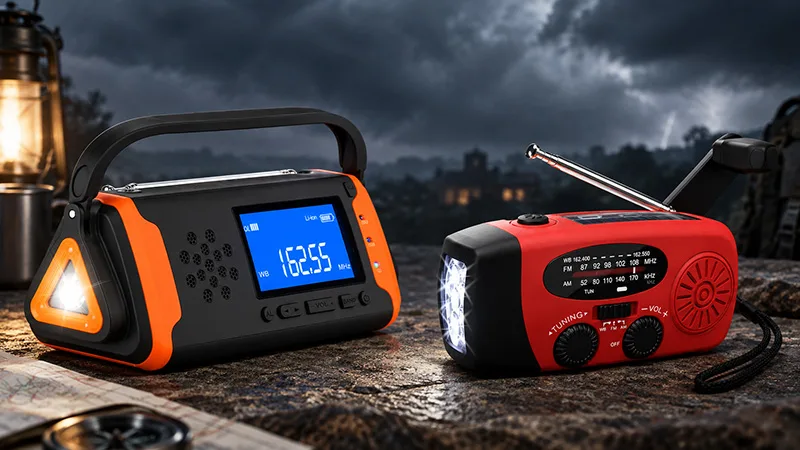

A crank radio, also called an emergency radio, receives AM and FM broadcasts. It also comes with features that can be valuable outdoors or in an emergency, such as a flashlight, an SOS signal and a power bank.
You can charge the built-in battery in several ways: with solar power, the built-in hand crank or a USB cable. Because you are less dependent on the power grid, a crank radio is good to have when the lights go out. But which crank radio is actually best?
We tested two different crank radios: a smaller one with a 2,000 mAh battery and a larger one with a 4,000 mAh battery. Here is our verdict on each model.
Crank radio with 2,000 mAh battery
The first thing we noticed when unboxing this radio was its size. At just over 5 inches long and only about 7 oz (200 g), it is extremely compact and portable. It actually looks like an ordinary flashlight.
The matte surface makes it comfortable to hold, and a wrist strap keeps you from dropping it.

Three ways to charge
The radio has a 2,000 mAh battery that you can charge in three ways:
- With the included USB cable. Always do this before heading out. A full charge takes about 2.5 hours.
- With the hand crank on the side. Fold out the handle and turn it counterclockwise. A full charge this way also takes about 2.5 hours, but just one minute of cranking gives you about 5 minutes of radio or 3 minutes of phone charging.
- With the solar panel. The solar panel on top is mainly meant for topping up, but in direct sunlight it can fully charge the battery in a little over 35 hours.
The battery also works as a power bank, and 2,000 mAh is plenty to give a phone an emergency charge. A full battery can charge a phone completely, or at least halfway.
Easy to use
This radio is simple to understand. The flashlight button sits on top, and the other buttons and the volume knob are on the side. The volume knob also works as the on/off switch. Our only complaint is that the knob can feel a little stiff at times.
Next to the buttons is a microSD card reader, for example for playing your own music. We did not test this feature, and it feels fairly unnecessary, especially since the sound quality is not this radio's strong point.
Then again, you can't expect spectacular sound given the compact size and low price. It is not meant to be a speaker but an emergency radio, and as a radio it clearly does its job.
All the essential features
- Two frequency bands (AM/FM). On FM you can tune in to local stations, which broadcast important public announcements during emergencies. AM lets you search for more distant stations if FM were to stop working.
- Antenna. The telescopic antenna improves reception and gives you a better signal.
- Flashlight. The built-in flashlight works well, although there are brighter models, including the second radio we tested.
Verdict
If you want an affordable emergency radio that does its job and is easy to carry, this is a good choice. It fits in your pocket, has all the important features and is very easy to use.
The sound could be better, the flashlight could be brighter, and there is no digital display, but that is far from a must. In short, this crank radio is well worth the money.
Pros
- Small and easy to carry in a pocket.
- Has all the essential features.
- microSD reader for playing music from a memory card.
Cons
- Not the best sound quality.
- The volume knob feels a bit stiff.
- No display.
Crank radio with 4,000 mAh battery
It is immediately clear that this is a more premium radio than the first model. It has a much sharper matte black design with orange details and weighs about 11 oz (300 g) more.
Because it is larger, it is also harder to hold, but the manufacturer solved that with a sturdy handle that gives you a good grip when carrying the radio or using the flashlight.

Four ways to charge
This model has twice the battery capacity, 4,000 mAh, and can be powered in four ways:
- USB cable. The charging port is under the flap on the side, next to the USB port you can use to charge your phone.
- Solar panel. The solar panel is considerably larger and sits on the back. Again, it is meant as a supplement; a full charge from solar alone takes about 35 hours.
- Hand crank. The crank is on the bottom and works the same way: fold it out and turn it counterclockwise.
- AAA batteries. A compartment on the bottom holds three AAA batteries, making this one of few emergency radios that can run on ordinary batteries.
LED display and intuitive buttons
The digital LED display makes it easy to adjust settings and shows the battery level and current frequency at a glance. The buttons below it are intuitive, and holding down the arrow button scans the available stations quickly.
Impressive sound and AUX input
We were genuinely impressed by the sound quality. It is good enough to use as a regular radio on a camping trip or at the beach.
You can also play your own music with the included AUX cable. Connect it to the radio and your phone, press the M button on the far left, and start playing.
SOS signal and a bright flashlight
The radio also has an SOS function that sounds a loud siren and makes the flashlight blink SOS in Morse code, ideal if you need to be found. The flashlight is considerably brighter than on the first radio and gives an even beam.
Verdict
If you want a crank radio with a little extra, you will probably not find a better model. Beyond the basics of power bank, flashlight and radio, it adds an AUX input, an SOS signal and an LED display, and it is one of few crank radios that runs on ordinary batteries.
The only downside is the size: it is bigger, heavier and won't fit in your pocket. It also costs a bit more, but in our view it is worth every penny.
Pros
- Works as a music player via AUX.
- Really good sound quality.
- Sharp LED display with intuitive buttons.
- Bright flashlight.
- SOS signal.
- Also runs on batteries.
Cons
- Can feel somewhat large and bulky.
- Costs a bit more.
Summary
It is hard to name a single winner, since different people value different features.
The radio with the smaller battery gives you a lot for the money and is perfect if you only want the most important features. It is small, easy to hold and gets the job done.
If you can spend a little more and don't need the lightest, most compact option, the second radio is clearly the better choice. You can use it as a regular radio and even a portable music player, it runs on batteries and it has an SOS signal.
Which emergency radio suits you best is up to you, but in our eyes the 4,000 mAh crank radio is the clear winner.